Parser class for integers. More...
#include <args.hh>
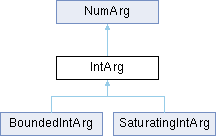
Inheritance diagram for IntArg:
Public Types | |
| typedef uint32_t | limb_type |
 Public Types inherited from NumArg | |
| enum | { status_ok = 0 , status_inval = EINVAL , status_range = ERANGE , status_notsup , status_unitless } |
Public Member Functions | |
| IntArg (int b=0) | |
| const char * | parse (const char *begin, const char *end, bool is_signed, int size, limb_type *value, int nlimb) |
| template<typename V > | |
| bool | parse_saturating (const String &str, V &result, const ArgContext &args=blank_args) |
| template<typename V > | |
| String | unparse (const V &v) |
| template<typename V > | |
| bool | parse (const String &str, V &result, const ArgContext &args=blank_args) |
Public Attributes | |
| int | base |
| int | status |
Protected Member Functions | |
| void | range_error (const ArgContext &args, bool is_signed, click_int_large_t value) |
Static Protected Member Functions | |
| static const char * | span (const char *begin, const char *end, bool is_signed, int &b) |
Detailed Description
Parser class for integers.
IntArg(base) reads integers in base base. base defaults to 0, which means arguments are parsed in base 10 by default, but prefixes 0x, 0, and 0b parse hexadecimal, octal, and binary numbers, respectively.
Integer overflow is treated as an error.
- See also
- SaturatingIntArg, BoundedIntArg
The documentation for this class was generated from the following files:
- include/click/args.hh
- lib/args.cc