The iterator type for HashTable. More...
#include <hashtable.hh>
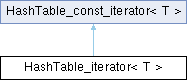
Inheritance diagram for HashTable_iterator< T >:
Public Types | |
| typedef HashTable_const_iterator< T > | inherited |
 Public Types inherited from HashTable_const_iterator< T > | |
| typedef bool(HashTable_const_iterator::* | unspecified_bool_type) () const |
Public Member Functions | |
| HashTable_iterator () | |
| Construct an uninitialized iterator. | |
| T * | get () const |
| Return a pointer to the element, null if *this == end(). | |
| T * | operator-> () const |
| Return a pointer to the element. | |
| T & | operator* () const |
| Return a reference to the element. | |
| Public Member Functions inherited from HashTable_const_iterator< T > | |
| HashTable_const_iterator () | |
| Construct an uninitialized iterator. | |
| const T * | get () const |
| Return a pointer to the element, null if *this == end(). | |
| const T * | operator-> () const |
| Return a pointer to the element. | |
| const T & | operator* () const |
| Return a reference to the element. | |
| HashTable< T >::key_const_reference | key () const |
| Return this element's key. | |
| bool | live () const |
| Return true iff *this != end(). | |
| operator unspecified_bool_type () const | |
| Return true iff *this != end(). | |
| void | operator++ (int) |
| Advance this iterator to the next element. | |
| void | operator++ () |
| Advance this iterator to the next element. | |
Detailed Description
template<typename T>
class HashTable_iterator< T >
class HashTable_iterator< T >
The iterator type for HashTable.
These iterators apply to HashTable classes that store either a unified key-value pair (HashTable<T>), or to HashTable classes that map keys to explicit values (HashTable<K, V>).
Iterators for HashTable<K, V> objects have additional methods. Given HashTable<K, V>::iterator it:
- *it has type Pair<const K, V>.
- it.key() returns the associated key, and is equivalent to it->first.
- it.value() returns the associated value, and is equivalent to it->second.
- it.value() is a mutable reference for iterator objects and a const reference for const_iterator objects.
Constructor & Destructor Documentation
◆ HashTable_iterator()
template<typename T >
|
inline |
Construct an uninitialized iterator.
Member Function Documentation
◆ get()
template<typename T >
|
inline |
Return a pointer to the element, null if *this == end().
◆ operator->()
template<typename T >
|
inline |
Return a pointer to the element.
- Precondition
- *this != end()
◆ operator*()
template<typename T >
|
inline |
Return a reference to the element.
- Precondition
- *this != end()
The documentation for this class was generated from the following file:
- include/click/hashtable.hh