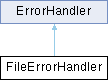
An ErrorHandler that prints error messages to a given file. More...
#include <error.hh>
Public Member Functions | |
| FileErrorHandler (FILE *f, const String &prefix=String()) | |
| Construct a FileErrorHandler. | |
| void | set_default_flags (int default_flags) |
| String | vformat (const char *fmt, va_list val) |
| Format an error string. | |
| void * | emit (const String &str, void *user_data, bool more) |
| Output an error message line. | |
| void | account (int level) |
| Account for an error message at level level. | |
 Public Member Functions inherited from ErrorHandler | |
| ErrorHandler () | |
| Construct an ErrorHandler. | |
| void | debug (const char *fmt,...) |
| Print a debug message (level el_debug). | |
| void | message (const char *fmt,...) |
| Print an informational message (level el_info). | |
| int | warning (const char *fmt,...) |
| Print a warning message (level el_warning). | |
| int | error (const char *fmt,...) |
| Print an error message (level el_error). | |
| int | fatal (const char *fmt,...) |
| Print a fatal error message (level el_fatal). | |
| void | ldebug (const String &landmark, const char *fmt,...) |
| Print a debug message with a landmark annotation. | |
| void | lmessage (const String &landmark, const char *fmt,...) |
| Print an informational message with a landmark annotation. | |
| int | lwarning (const String &landmark, const char *fmt,...) |
| Print a warning message with a landmark annotation. | |
| int | lerror (const String &landmark, const char *fmt,...) |
| Print an error message with a landmark annotation. | |
| int | lfatal (const String &landmark, const char *fmt,...) |
| Print a fatal error message with a landmark annotation. | |
| int | xmessage (const String &str) |
| Print an annotated error message. | |
| int | xmessage (const String &anno, const String &str) |
| Print an error message, adding annotations. | |
| int | xmessage (const String &anno, const char *fmt, va_list val) |
| Format and print an error message, adding annotations. | |
| int | xmessage (const String &landmark, const String &anno, const String &str) |
| Print an error message, adding landmark and other annotations. | |
| int | xmessage (const String &landmark, const String &anno, const char *fmt, va_list val) |
| Format and print an error message, adding landmark and other annotations. | |
| int | nerrors () const |
| Return the number of errors reported via this handler. | |
| String | format (const char *fmt,...) |
| Format an error string. | |
| virtual String | decorate (const String &str) |
| Decorate an error message. | |
| virtual void | clear () |
| Clear accumulated error state. | |
Additional Inherited Members | |
| Public Types inherited from ErrorHandler | |
| enum | Level { el_abort = -999 , el_fatal = -1 , el_emergency = 0 , el_alert = 1 , el_critical = 2 , el_error = 3 , el_warning = 4 , el_notice = 5 , el_info = 6 , el_debug = 7 } |
| Error level constants. More... | |
| enum | ConversionFlags { cf_zero_pad = 1 , cf_plus_positive = 2 , cf_space_positive = 4 , cf_left_just = 8 , cf_alternate_form = 16 , cf_singlequote = 32 , cf_uppercase = 64 , cf_signed = 128 , cf_negative = 256 , cf_utf8 = 1024 } |
| typedef String(* | ConversionFunction) (int flags, VA_LIST_REF_T) |
| Static Public Member Functions inherited from ErrorHandler | |
| static ErrorHandler * | static_initialize (ErrorHandler *errh) |
| Initialize the ErrorHandler implementation. | |
| static void | static_cleanup () |
| Tear down the ErrorHandler implementation. | |
| static ErrorHandler * | default_handler () |
| Return the default ErrorHandler. | |
| static void | set_default_handler (ErrorHandler *errh) |
| Set the default ErrorHandler to errh. | |
| static ErrorHandler * | silent_handler () |
| Return the global silent ErrorHandler. | |
| static String | xformat (int default_flags, const char *fmt,...) |
| Format an error string. | |
| static String | vxformat (int default_flags, const char *fmt, va_list val) |
| static String | xformat (const char *fmt,...) |
| static String | vxformat (const char *fmt, va_list val) |
| static String | make_anno (const char *name, const String &value) |
| Create an error annotation. | |
| static String | combine_anno (const String &str, const String &anno) |
| Apply annotations from anno to every line in str. | |
| static const char * | parse_anno (const String &str, const char *begin, const char *end,...) ERRH_SENTINEL |
| Parse error annotations from a string. | |
| static const char * | skip_anno (const char *begin, const char *end) |
| Skip a string's error annotations. | |
| static String | make_landmark_anno (const String &x) |
| Return a landmark annotation equal to x. | |
| static String | clean_landmark (const String &landmark, bool colon=false) |
| Clean the landmark. | |
| static Conversion * | add_conversion (const String &name, ConversionFunction func) |
| static int | remove_conversion (Conversion *conversion) |
| Static Public Attributes inherited from ErrorHandler | |
| static const char | e_abort [] = "<-999>" |
| Error level indicators. | |
| static const char | e_fatal [] = "<-1>" |
| static const char | e_emergency [] = "<0>" |
| static const char | e_alert [] = "<1>" |
| static const char | e_critical [] = "<2>" |
| static const char | e_error [] = "<3>" |
| static const char | e_warning [] = "<4>" |
| static const char | e_warning_annotated [] = "<4>warning: " |
| static const char | e_notice [] = "<5>" |
| static const char | e_info [] = "<6>" |
| static const char | e_debug [] = "<7>" |
| static const int | ok_result = 0 |
| static const int | error_result = -EINVAL |
Detailed Description
An ErrorHandler that prints error messages to a given file.
FileErrorHandler is the typical base ErrorHandler used at user level. It prints messages to a file passed in to the constructor, and calls exit() or abort() based on the error level.
Constructor & Destructor Documentation
◆ FileErrorHandler()
Construct a FileErrorHandler.
- Parameters
-
f file to print errors prefix string to prefix every error line
Member Function Documentation
◆ vformat()
|
virtual |
Format an error string.
- Parameters
-
fmt format string val argument list
- Warning
- ErrorHandler users don't need to call this function directly; it is called implicitly by the error()/xmessage() functions.
This virtual function is called to format an error message. The default implementation returns the result of vxformat(fmt, val).
Reimplemented from ErrorHandler.
◆ emit()
|
virtual |
Output an error message line.
- Parameters
-
str error message line, possibly with annotations user_data callback data, 0 for first line in a message more true iff this is the last line in the current message
- Returns
- user_data to be passed to emit() for the next line
- Warning
- ErrorHandler users don't need to call this function directly; it is called implicitly by the error()/xmessage() functions.
After calling decorate(), ErrorHandler splits the message into individual lines and calls emit() once per line. ErrorHandler subclasses should output the error lines as appropriate; for example, FileErrorHandler outputs the error message to a file.
str does not contain a newline, but may contain annotations, including a landmark annotation. Most ErrorHandlers use parse_anno() to extract the landmark annotation, clean it with clean_landmark(), and print it ahead of the error message proper.
ErrorHandler can handle multi-line error messages. However, the emit() function takes a line at a time; this is more useful in practice for most error message printers. The user_data and more arguments can help an ErrorHandler combine the lines of a multi-line error message. user_data is null for the first line; for second and subsequent lines, ErrorHandler passes the result of the last line's emit() call. more is true iff this is the last line in the current message.
The default emit() implementation does nothing.
Reimplemented from ErrorHandler.
◆ account()
|
virtual |
Account for an error message at level level.
- Parameters
-
level minimum error level in the message
- Warning
- ErrorHandler users don't need to call this function directly; it is called implicitly by the error()/xmessage() functions.
After calling emit() for the lines of an error message, ErrorHandler calls account(), passing the minimum (worst) error level of any message line (or 1000 if no line had a level). The default implementation updates the nerrors() counter. Some other ErrorHandlers add account() behavior that, for example, exits after printing messages at el_fatal level or below.
Reimplemented from ErrorHandler.
The documentation for this class was generated from the following files:
- include/click/error.hh
- lib/error.cc